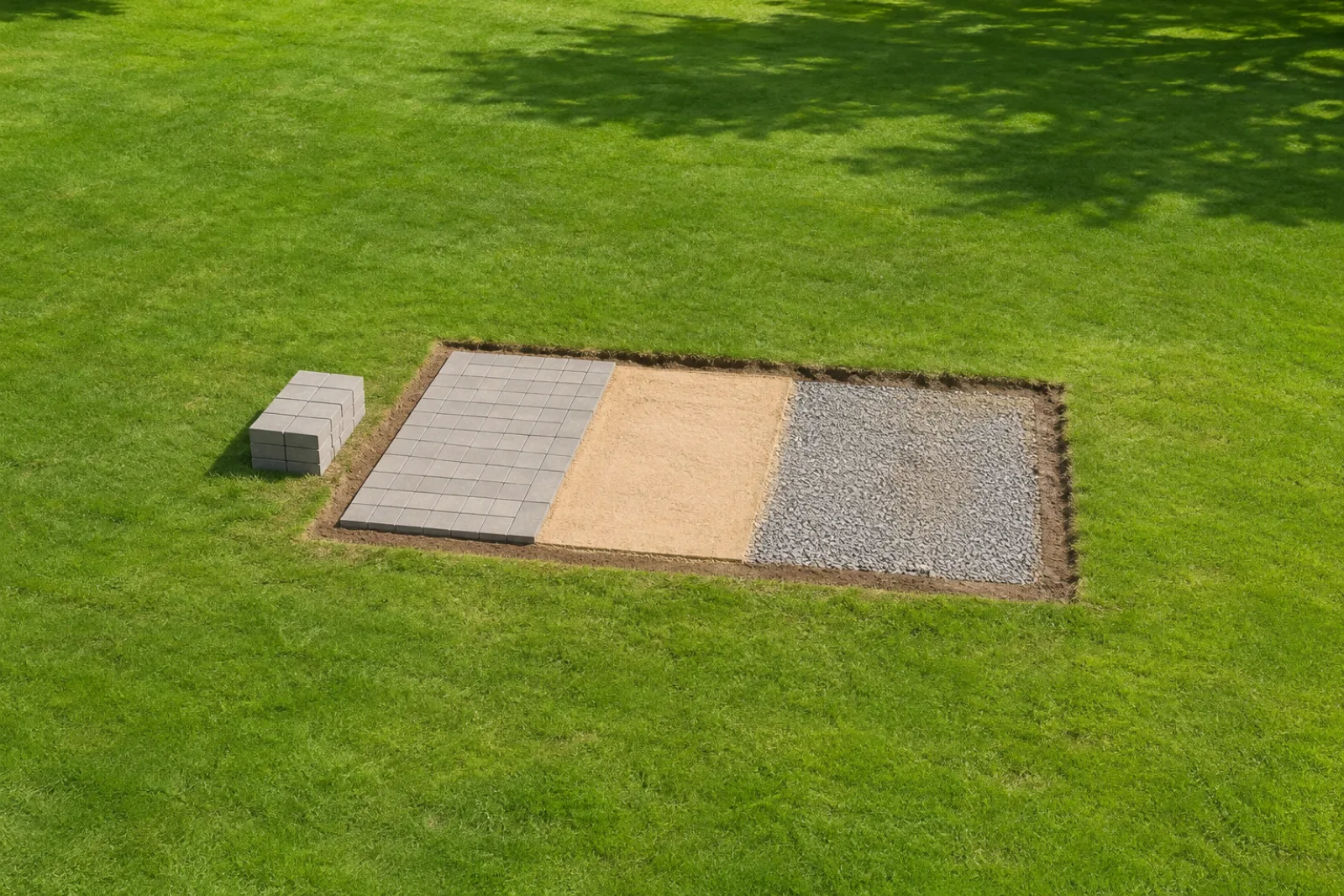
How Much Mulch Do I Need? Cubic Yards, Bags and Depth
LandLens6 min read
Work out how much mulch you need: measure the bed, pick a depth, and convert to cubic yards or bags. Formulas, coverage table and examples for odd-shaped beds.
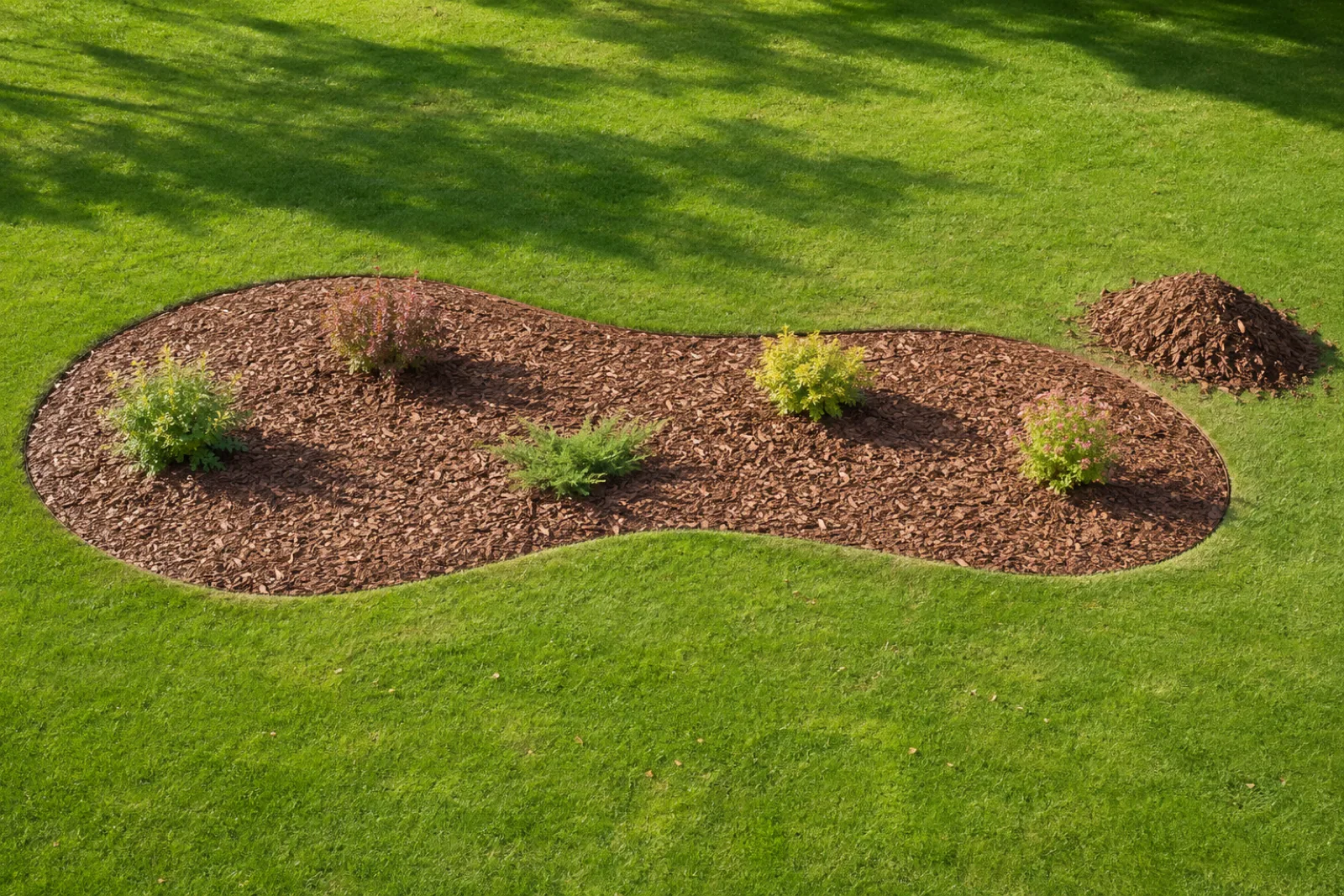
To know how much mulch you need, multiply the bed area in square feet by the depth in inches and divide by 324. The answer is cubic yards. At 3 inches deep, one cubic yard covers about 108 square feet. For bags, multiply cubic yards by 27 and divide by the bag size in cubic feet.
The formula
Cubic yards = area (sq ft) × depth (inches) ÷ 324
The 324 comes from the units: a cubic yard is 27 cubic feet, and a foot is 12 inches, so 27 × 12 = 324. It is the same as multiplying length, width and depth in inches and dividing by 46,656, the number of cubic inches in a cubic yard.
In metric it is simpler: cubic meters = area (m²) × depth (cm) ÷ 100. A 20 m² bed at 7.5 cm needs 1.5 m³.
How much one cubic yard covers
| Depth | Area covered by 1 cubic yard | Cubic yards per 100 sq ft |
|---|---|---|
| 1 inch | 324 sq ft | 0.31 |
| 2 inches | 162 sq ft | 0.62 |
| 3 inches | 108 sq ft | 0.93 |
| 4 inches | 81 sq ft | 1.23 |
Try LandLens free
How deep should mulch be?
- Fine mulch (finely shredded bark, compost): 1 to 2 inches.
- Coarse mulch around plants (wood chips, nuggets): 3 to 4 inches.
- Trees and shrubs on well-drained soil: 3 to 4 inches of wood chips or shredded bark, according to Iowa State University Extension.
- Heavy (clay) soils: 2 to 3 inches, from the same source.
Keep mulch at least 6 inches away from tree trunks. Mulch heaped against the trunk can encourage fungal cankers, root rot and rodents, as Iowa State Extension warns. That gap also matters for the math: a tree ring is a donut, not a full circle.
Step 1: Measure the area of each bed
Mulch orders go wrong at this step more often than at the math. Pick the method that fits the shape:
- Rectangle: length × width. A 20 × 15 ft bed is 300 sq ft.
- Circle: 3.14 × radius × radius. A ring 8 ft across has a 4 ft radius: 3.14 × 4 × 4 = 50 sq ft. The circle area calculator does this for you.
- Tree ring with a trunk gap: subtract the inner circle. A 4 ft radius ring with a 6 inch gap around a trunk that is about 1 ft wide: 3.14 × (4 × 4 − 1 × 1) = 47 sq ft.
- Curved or odd-shaped beds: split the bed into rectangles and triangles and add them up, or trace the outline on a map.
For curved beds along a house, a driveway or a fence, tracing is faster than a tape. In LandLens you tap the corners of the bed on a satellite map, or walk its edge with GPS, and the app shows the area in square feet or square meters. Measure each bed as its own shape and add them up. Satellite images can be a little off at the edge of a narrow bed, so check one side with a tape. For whole-yard projects, see how to measure your yard for landscaping.
Step 2: Convert to cubic yards or bags
Bagged mulch is sold by volume. The common sizes are 2 cubic feet and 3 cubic feet.
| Bag size | Bags per cubic yard |
|---|---|
| 2 cu ft | 13.5 (buy 14) |
| 3 cu ft | 9 |
| 50 L (metric) | about 15.3 (20 per m³) |
Bags = cubic yards × 27 ÷ bag size (cu ft). Always round up to a whole bag.
Worked examples
Example 1: Rectangular bed, 3 inches deep
- Area = 20 × 15 = 300 sq ft
- Cubic yards = 300 × 3 ÷ 324 = 2.78, so order 3 cubic yards
- In 2 cu ft bags: 2.78 × 27 = 75 cu ft, ÷ 2 = 37.5, so 38 bags
Example 2: Three tree rings, 3 inches deep
- Each ring = 47 sq ft (4 ft radius, trunk gap removed), so 3 rings = 141 sq ft
- Cubic yards = 141 × 3 ÷ 324 = 1.31
- In 3 cu ft bags: 1.31 × 27 ≈ 35.4 cu ft, ÷ 3 = 11.8, so 12 bags
Example 3: Curved front bed, topped up 2 inches
- Area traced on a map = 240 sq ft
- Cubic yards = 240 × 2 ÷ 324 = 1.48, so order 1.5 cubic yards bulk
- In 2 cu ft bags: 1.48 × 27 = 40 cu ft, ÷ 2 = 20 bags
Bags or bulk?
Bags are easy to carry and store, and they suit small jobs and top-ups. Bulk is sold by the cubic yard; ask the supplier about a minimum order and delivery fee before you compare. Compare the price per cubic yard both ways: one cubic yard is 13.5 bags of 2 cu ft.
Do the math faster
The free mulch calculator takes the area in square feet, square meters or acres and the depth in inches or centimeters, and gives volume, bag count and cost. If you are also adding soil under new beds, the soil calculator uses the same area.
Frequently asked questions
How many square feet does a yard of mulch cover?
One cubic yard covers 324 sq ft at 1 inch, 162 sq ft at 2 inches, 108 sq ft at 3 inches and 81 sq ft at 4 inches. Divide 324 by your depth in inches.
How many bags of mulch are in a yard?
A cubic yard is 27 cubic feet: 13.5 bags of 2 cu ft (buy 14) or 9 bags of 3 cu ft.
How much mulch do I need for 1,000 square feet?
At 2 inches, 1,000 × 2 ÷ 324 = 6.2 cubic yards. At 3 inches, 9.3 cubic yards.
Can I put new mulch on top of old mulch?
Yes, but measure what is already there first. Subtract the depth that is still there from your target depth and order only the difference, so the total stays within the recommended range.
How do I measure a bed with curves?
Split it into simple shapes and add their areas, or trace the outline on a satellite map with a phone app. Tracing is quicker for long beds that follow a path, a lawn edge or a fence.
Related tools & guides
Try LandLens free
Measure any land area, distance, or perimeter with your iPhone, iPad or Android phone. No equipment needed.
Share Your Feedback
Help us build a better LandLens. Request features, report bugs, or tell us what you think.