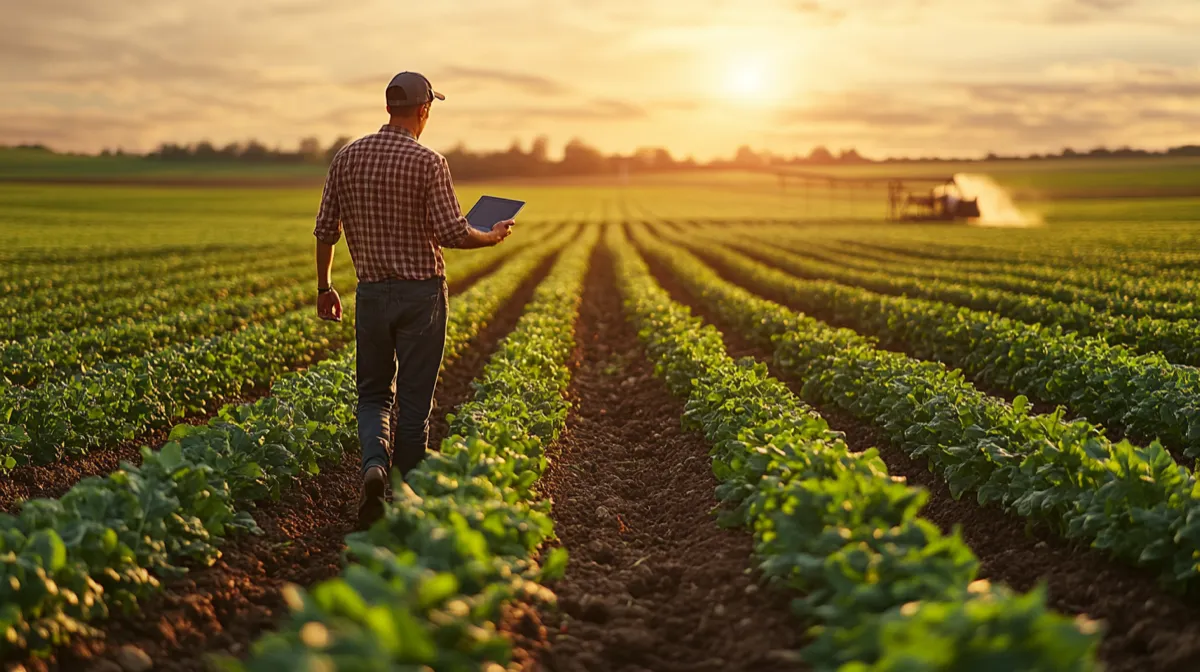
Every growing season, farmers leave money on the ground — sometimes literally — by guessing how much fertilizer, seed, or herbicide to buy. Over-apply fertilizer and you burn cash while risking nutrient runoff and soil degradation. Under-apply and your yield drops across every row. The difference between guessing and knowing comes down to one thing: an accurate field area measurement.
This guide walks through the complete process, from measuring your fields to calculating exact input quantities for fertilizer, seed, herbicides, and irrigation. We will use real-world prices, actual crop rates, and worked-out math so you can apply these calculations to your own operation today.
Why Accurate Field Area Matters for Input Costs
Input costs are the single largest controllable expense on most farms. In 2026, U.S. farmers are spending roughly $150-180 per acre on fertilizer alone for corn, with seed adding another $100-130 per acre. On a 500-acre operation, that is $125,000 to $155,000 in fertilizer and seed before a single plant emerges.
When your field area measurement is off by even 5%, the financial consequences multiply fast. Consider a farmer who estimates a field at 100 acres when it actually measures 95 acres. At $170 per acre in fertilizer costs, that 5-acre overestimate means $850 in wasted fertilizer — on just one field, for one application. Over a full season with multiple fields and multiple passes, measurement errors routinely cost small-to-mid-size farms $2,000 to $5,000 per year.
Under-application is arguably worse. If you think a field is 90 acres but it is actually 97, you are spreading 90 acres' worth of nitrogen across 97 acres. That 7% shortfall in nitrogen on corn can reduce yield by 10-15 bushels per acre. At $4.50 per bushel, you are looking at $4,400 to $6,500 in lost revenue — all because of a measurement error.
Precision starts with measurement. Everything else is arithmetic.
Step 1: Measure Your Field Accurately
The old method — pacing off field edges, estimating from property deeds, or eyeballing satellite images — introduces errors of 10-20% on irregularly shaped fields. Fields are rarely perfect rectangles. They have tree lines, waterways, drainage ditches, rock outcroppings, and odd corners that defy simple length-times-width math.
Measuring agricultural fields with GPS for accurate input calculations
Modern GPS measurement using a smartphone is far more accurate and takes minutes instead of hours. When you measure your fields by walking the perimeter with a GPS-enabled app, you capture every curve and irregularity. The result is a precise polygon area, not an approximation.
With LandLens on your iPhone or iPad, the process takes about five minutes per field:
- Open the area measurement tool (the polygon icon) and walk to any corner of your field.
- Tap to place your first pin. Stand still for a few seconds so the GPS locks in.
- Walk the perimeter, placing pins at every corner and along curves. For curved edges, drop a pin every 15-20 feet to capture the true shape. You can also use GPS tracking mode, which drops points automatically as you walk.
- Close the shape by connecting back to your first point. The area displays immediately in your preferred land measurement units — acres, hectares, square meters, or others.
- Save and name the field (e.g., "South 40 - Corn 2026") for quick reference all season.
For more on what to expect from smartphone positioning, see our guide on GPS accuracy for land measurement. In open agricultural fields with clear sky view, modern phones typically achieve 1-3 meter accuracy, which translates to less than 1% area error on fields larger than 5 acres.
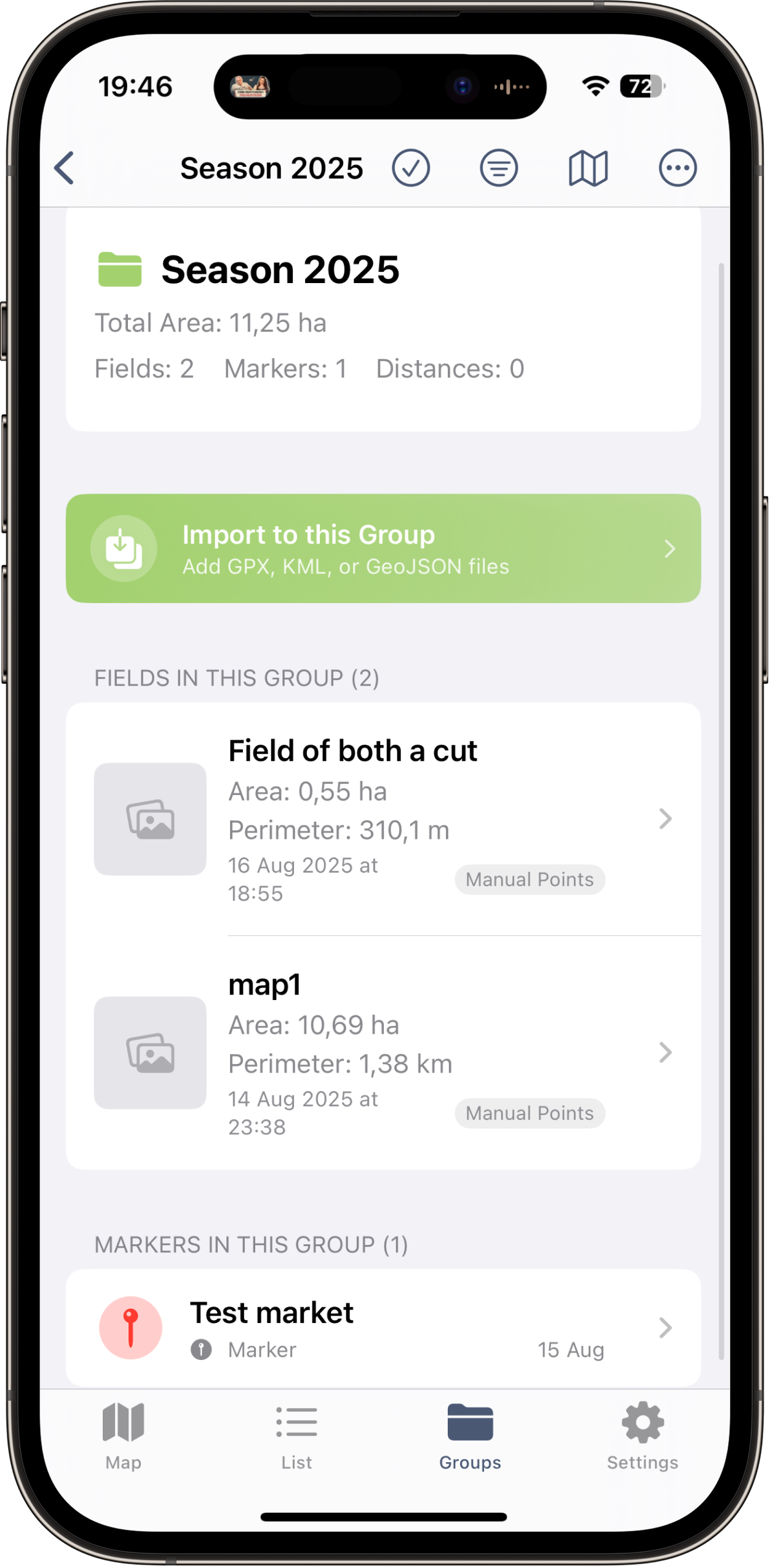
GPS field measurement for precise acreage
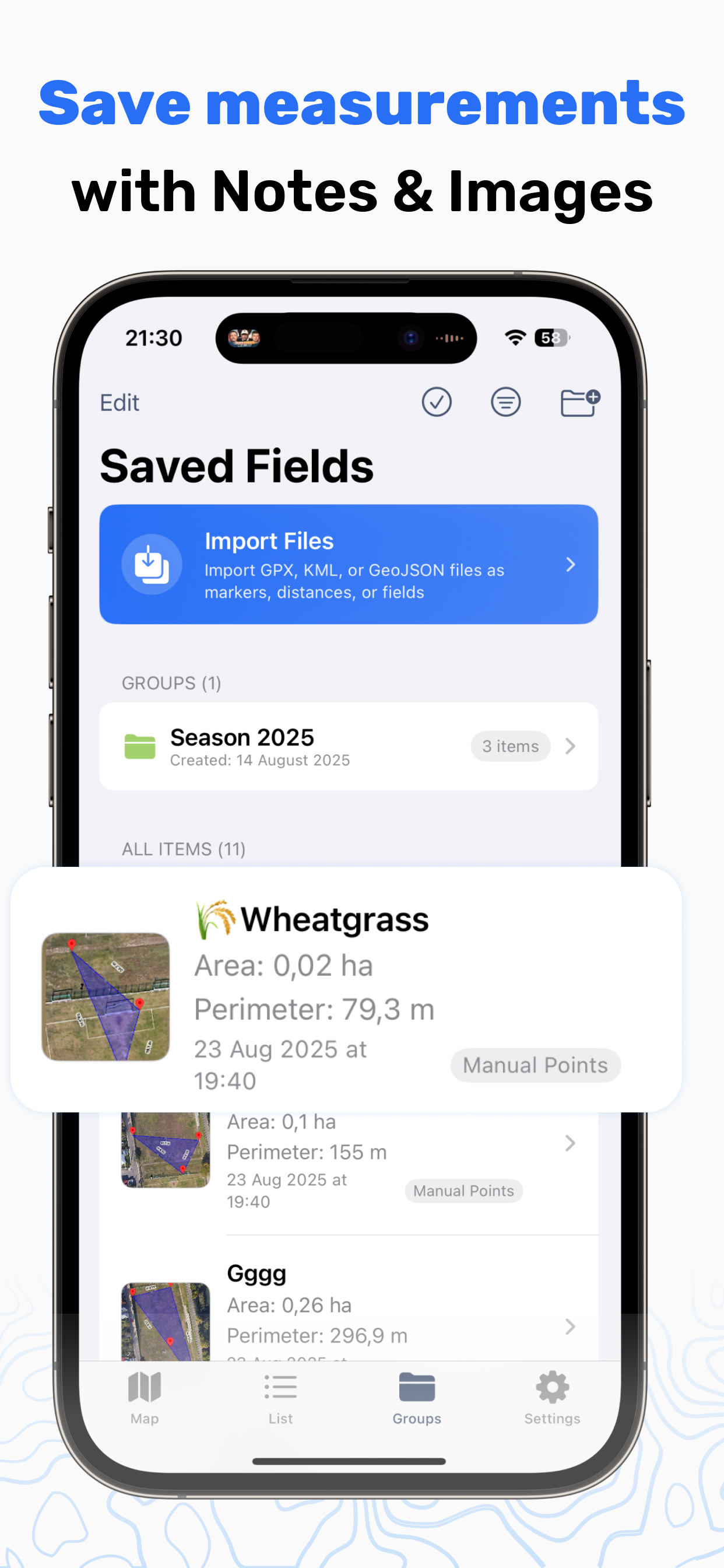
Accurate acreage for input calculations
💰 Cost Impact of 5% Measurement Error
On a 100-acre operation:
- Fertilizer waste: $850-1,000 per application
- Seed over-ordering: $1,500-1,750 per season
- Chemical over-application: $300-500 per spray
Total annual waste: $2,650-3,250
Understanding Fertilizer Labels
Before you can calculate how much fertilizer to buy, you need to understand what is in the bag. Every fertilizer label displays three numbers — the N-P-K ratio — which represent the percentage by weight of three primary nutrients:
- N (Nitrogen): Drives vegetative growth, leaf development, and protein content. The most commonly supplemented nutrient.
- P (Phosphorus): Listed as P2O5 on labels. Supports root development, flowering, and fruiting.
- K (Potassium): Listed as K2O on labels. Strengthens cell walls, improves drought tolerance, and enhances disease resistance.
So a bag labeled 46-0-0 (urea) is 46% nitrogen and contains no phosphorus or potassium. A bag labeled 10-10-10 is 10% each of N, P2O5, and K2O — meaning 70% of the bag weight is filler or carrier material.
Synthetic vs. Organic Fertilizers
Synthetic fertilizers (urea, DAP, muriate of potash) have high, precise nutrient concentrations. They act fast and are easy to calculate with. A 50 lb bag of urea at 46-0-0 delivers exactly 23 lbs of actual nitrogen.
Organic fertilizers (composted manure, bone meal, blood meal, fish emulsion) have lower, more variable nutrient content. Composted dairy manure might test at roughly 1-2% N, 0.5-1% P, and 1-2% K, but the exact numbers vary by source and composting process. You need a lot more volume to deliver the same nutrients, and you should get a lab analysis for accurate calculations.
For the calculations below, we will focus on synthetic fertilizers because of their consistent concentrations, but the formulas work the same for organics — you just use the actual nutrient percentages from your lab test.
Calculating Fertilizer Application Rates
The master formula is straightforward:
Product needed (lbs) = (Nutrient needed per acre / Nutrient percentage in product) x Field area in acres
Worked Example 1: Nitrogen for Corn (U.S. Acres)
Your soil test recommends 180 lbs of actual nitrogen per acre for your corn field. You plan to apply urea (46-0-0). Your field measures 65 acres in LandLens.
Step 1: Product per acre = 180 lbs N / 0.46 = 391 lbs of urea per acre
Step 2: Total product = 391 lbs x 65 acres = 25,415 lbs of urea (about 12.7 tons)
Step 3: At roughly $520 per ton for urea in early 2026, that is approximately $6,604 in urea for this one field.
If you had estimated the field at 70 acres instead of the actual 65, you would have bought 27,370 lbs — an extra 1,955 lbs of urea you did not need, costing about $508 extra.
Worked Example 2: DAP for Wheat (Metric/Hectares)
Your agronomist recommends 100 kg of DAP (18-46-0) per hectare at planting for winter wheat. Your field measures 12.4 hectares.
Total DAP needed: 100 kg/ha x 12.4 ha = 1,240 kg of DAP
This delivers: 1,240 x 0.18 = 223.2 kg of actual nitrogen, and 1,240 x 0.46 = 570.4 kg of P2O5.
At 50 kg bags, you need 25 bags. At roughly $38 per bag, your cost is $950.
Split Applications
Many crops benefit from split fertilizer applications rather than a single dump. For rice, nitrogen is commonly split three ways: 40% at basal (pre-plant), 30% at tillering, and 30% at panicle initiation. For corn, a common split is 30% at planting and 70% as side-dress at V6-V8 stage. Calculate the total first, then divide according to your split schedule.
Seed Rate Calculations
Seed rates can be expressed as weight per acre (for small grains) or as seeds per acre (for row crops like corn and soybeans). Here are typical 2026 rates for major crops:
Corn / Maize
Typical planting rate: 32,000-36,000 seeds per acre (79,000-89,000 seeds per hectare). A standard bag contains 80,000 kernels. At 34,000 seeds/acre on a 65-acre field, you need: 65 x 34,000 = 2,210,000 seeds = 28 bags (rounding up). At $300-350 per bag in 2026, that is $8,400 to $9,800 in seed corn.
Soybeans
Typical planting rate: 130,000-150,000 seeds per acre (321,000-370,000 per hectare). A standard unit is 140,000 seeds. At 140,000 seeds/acre on 65 acres: 65 x 140,000 = 9,100,000 seeds = 65 units. At $55-70 per unit, that is $3,575 to $4,550.
Wheat
Typical seeding rate: 1.2-1.6 million seeds per acre, or roughly 90-120 lbs per acre (100-135 kg/hectare). At 100 lbs/acre on 65 acres: 6,500 lbs = roughly 108 bushels of seed wheat. At $12-16 per bushel, that is $1,296 to $1,728.
Rice
Drill-seeded rice: 60-90 lbs per acre (70-100 kg/hectare). Transplanted rice requires less seed — roughly 30-50 lbs per acre (35-55 kg/hectare) — because seedlings are raised in a nursery first. At 75 lbs/acre direct-seeded on a 40-acre rice paddy: 3,000 lbs of seed.
In every case, the calculation is only as good as your field area measurement. Ordering 28 bags of seed corn when you actually need 26 means two bags — $600 to $700 — sitting in storage.
Herbicide and Pesticide Rates
Chemical application rates demand even greater precision than fertilizer. There are three reasons why:
- Label compliance is law. In the U.S., the EPA-registered label is a legal document. Applying above the labeled rate is a federal violation. Accurate field area is your first line of defense against accidental over-application.
- Under-application fails. Apply 80% of the labeled rate of a pre-emergent herbicide and you will get poor weed control, wasting the entire cost of the application and likely requiring a follow-up spray.
- Chemicals are expensive. A broadleaf herbicide like dicamba might cost $12-18 per acre. A fungicide pass on wheat might run $15-22 per acre. On 100 acres, even a 5% area error means $60 to $110 wasted per application — or worse, an under-dosed field with a weed escape.
When mixing a spray tank, the calculation follows the same pattern: rate per acre multiplied by the number of acres you will spray. A 10-acre measurement error on a 200-acre field means your tank mix is off by 5%, which can push you out of the effective application window for the product.
Always measure spray fields carefully and double-check by comparing GPS-measured area against your tank volume calculations. If your 300-gallon tank should cover exactly 15 acres at 20 gallons per acre, and you run out at 14 acres, something is off — either your measurement or your nozzle calibration.
Irrigation Planning Based on Field Area
Irrigation planning ties directly to field area. The fundamental unit is the acre-inch — one inch of water applied over one acre, which equals approximately 27,154 gallons (102,790 liters).
Corn at peak demand (tasseling) in the Midwest requires about 0.30-0.35 inches of water per day. For a 130-acre center-pivot field, that means:
130 acres x 0.33 inches/day x 27,154 gallons/acre-inch = 1,164,507 gallons per day at peak demand.
Your well and pump must deliver this volume within the hours you plan to run. If you are irrigating 20 hours per day, you need a flow rate of about 970 gallons per minute. Undersizing your system because you underestimated the field area means you cannot keep up during the critical weeks, and yield suffers accordingly.
For drip irrigation on smaller vegetable or orchard operations, you calculate water needs per plant or per row-foot, then multiply by the total irrigated area. Again, knowing the exact planted area is the starting point for proper system design.
Variable Rate Application
Variable rate technology (VRT) takes precision one step further. Instead of applying a uniform rate across the entire field, VRT uses prescription maps to vary the application rate zone by zone based on soil tests, yield data, or satellite imagery.
For example, a 100-acre field might have sandy soil on the south end (needing 200 lbs N/acre) and heavy clay on the north end (needing only 140 lbs N/acre). A uniform 170 lb rate over-applies on the clay and under-applies on the sand. VRT matches the rate to the need.
The foundation for VRT is an accurate field boundary map with georeferenced zones. This starts with precise field measurement. Many farmers use apps like LandLens to establish the field boundary, then export to farm software in KML or Shapefile format where the boundary can be overlaid with soil sampling data to create variable rate prescriptions.
Even if you are not using VRT equipment today, having accurate, exportable field maps puts you in a position to adopt precision agriculture tools as they become more accessible and affordable.
Cost Savings from Accurate Measurement
Let us put concrete numbers on what precision measurement saves. We will use a hypothetical 400-acre row crop farm growing corn and soybeans in a typical Midwest rotation, with field areas that are 5% larger than what the farmer had been estimating.
Scenario: 5% Over-Estimation on 400 Acres
The farmer thinks he has 400 acres but actually has 380. He has been buying inputs for 400 acres every year.
| Input | Cost per Acre | Overspend (20 acres excess) |
|---|---|---|
| Nitrogen fertilizer (corn acres) | $95 | $950 (on 10 excess corn acres) |
| Phosphorus & Potash | $55 | $1,100 (on 20 excess acres) |
| Corn seed | $120 | $1,200 (on 10 excess corn acres) |
| Soybean seed | $60 | $600 (on 10 excess soy acres) |
| Herbicide (2 passes) | $30 | $600 (on 20 excess acres) |
| Crop insurance premium | $20 | $400 (on 20 excess acres) |
| Total Annual Overspend | $4,850 |
Nearly $5,000 per year — gone — because of a measurement error that takes 30 minutes to fix with a GPS app and a walk around the fields. Over five years, that is $24,250. For a mid-size operation with 1,000+ acres, the annual savings from accurate measurement can exceed $10,000.
And this does not account for the environmental cost. Excess nitrogen and phosphorus leaving fields via runoff contribute to water quality problems. Applying only what the crop needs is good stewardship and increasingly a regulatory expectation.
Using LandLens for Farm Field Management
LandLens is designed for exactly this workflow. Here is how farmers use it through the season:
- Measure every field once. Walk the perimeter or drive it on an ATV with your phone mounted. Save each field with a descriptive name. This is a one-time task unless field boundaries change.
- Organize with folders. Create folders by farm, by crop, or by year. For example: "Home Farm > Corn 2026" and "Home Farm > Soybeans 2026." When you rotate crops next year, you still have the field boundaries — just reorganize them into new folders.
- Pull up area instantly for calculations. When your agronomist calls with a fertilizer recommendation in lbs/acre, open LandLens, tap the field, read the area, and multiply. No searching for paperwork or trying to remember estimates.
- Export for farm management software. LandLens exports field boundaries in KML, KMZ, GeoJSON, and Shapefile formats. Import these into John Deere Operations Center, Climate FieldView, Trimble Ag Software, or any other platform that accepts standard geospatial files.
- Track distances too. Need to measure a fence line, irrigation run, or drainage tile route? Use the distance tool in the same app, on the same map, organized alongside your field areas.
The key advantage is having all your field data in one place, on the phone you already carry, accessible offline in the field and exportable to any system you use.
Quick Reference: Common Application Rates
Use the tables below as starting points. Always confirm with local soil tests and extension recommendations for your specific conditions.
Fertilizer Rates
| Fertilizer (N-P-K) | Rate per Acre (lbs) | Rate per Hectare (kg) | Typical Use |
|---|---|---|---|
| Urea (46-0-0) | 175-390 | 195-435 | Primary nitrogen source, all crops |
| DAP (18-46-0) | 90-200 | 100-225 | Starter fertilizer at planting |
| MAP (11-52-0) | 80-175 | 90-195 | High-phosphorus starter |
| Potash / MOP (0-0-60) | 70-200 | 80-225 | Potassium supplementation |
| NPK 10-10-10 | 200-400 | 225-450 | General-purpose balanced |
| NPK 15-15-15 | 180-270 | 200-300 | Balanced, higher concentration |
| Ammonium Sulfate (21-0-0-24S) | 150-350 | 170-390 | Nitrogen + sulfur |
| UAN 28% (liquid) | 35-65 gal | 330-610 L/ha | Liquid nitrogen, side-dress |
Seed Rates
| Crop | Rate per Acre | Rate per Hectare | Notes |
|---|---|---|---|
| Corn / Maize | 32,000-36,000 seeds | 79,000-89,000 seeds | ~28-32 lbs/acre |
| Soybeans | 130,000-150,000 seeds | 321,000-370,000 seeds | ~55-70 lbs/acre |
| Wheat (winter) | 90-120 lbs | 100-135 kg | 1.2-1.6M seeds/acre |
| Wheat (spring) | 80-110 lbs | 90-125 kg | Slightly lower than winter |
| Rice (direct seeded) | 60-90 lbs | 70-100 kg | Higher rate than transplanted |
| Rice (transplanted) | 30-50 lbs | 35-55 kg | Nursery-raised seedlings |
| Cotton | 28,000-44,000 seeds | 69,000-109,000 seeds | ~10-18 lbs/acre |
| Sunflower | 17,000-23,000 seeds | 42,000-57,000 seeds | 3-5 lbs/acre |
Putting It All Together
The workflow for any farm input calculation is the same three steps:
- Measure the field accurately. Use GPS — not estimation — and save the measurement so you never have to redo it.
- Get the recommended rate from your soil test, agronomist, seed label, or chemical label.
- Multiply rate by area. Order that amount, plus a small buffer (typically 2-3%) for calibration and end-row overlap.
That is the entire process. The math is elementary school multiplication. The part that trips farmers up year after year is step one — having a field area number they can trust.
If you have been estimating, grab your phone, install LandLens, and walk your fields this weekend. It takes five minutes per field. Those measurements will pay for themselves the first time you use them to order fertilizer, and they will keep saving you money every season after that.
Measure once. Calculate confidently. Stop buying inputs you do not need.
Related tools & guides
Try LandLens free
Measure any land area, distance, or perimeter with your iPhone, iPad or Android phone. No equipment needed.
Share Your Feedback
Help us build a better LandLens. Request features, report bugs, or tell us what you think.