How Much Topsoil Do I Need? Cubic Yards, Depth and Bags
LandLens6分で読めます
How much topsoil you need for a new lawn, sod, garden bed or raised bed: cubic yards from area and depth, depth by project, coverage per yard and bags.
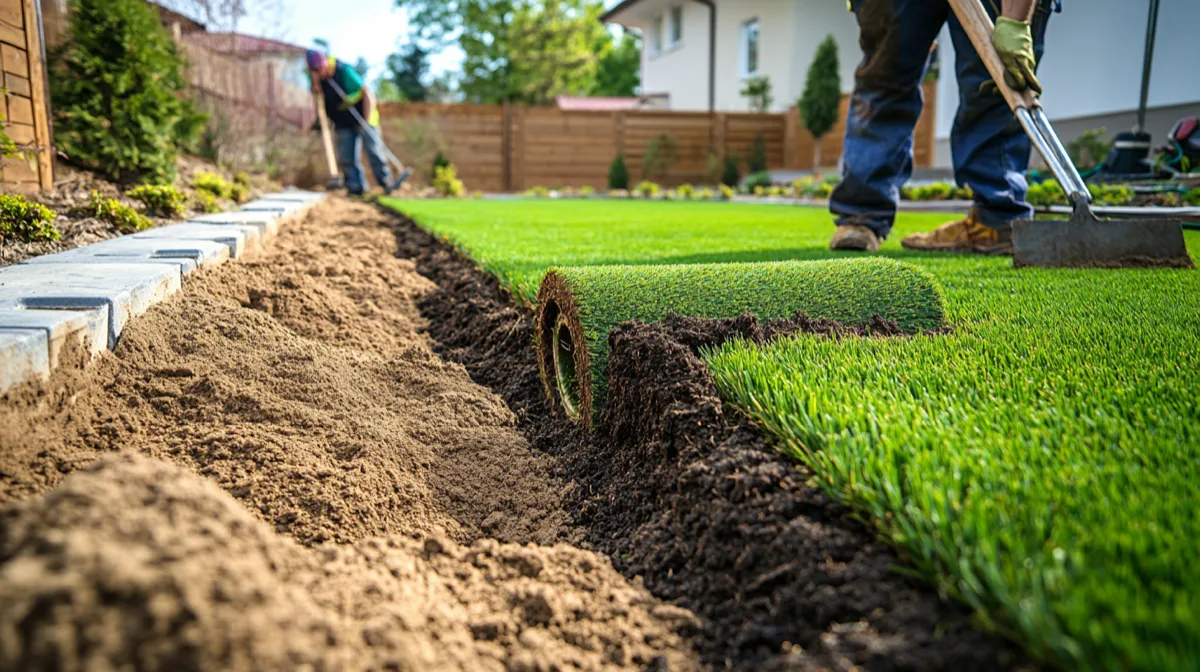
Multiply the area in square feet by the depth in inches and divide by 324 to get cubic yards. A new lawn from seed needs 4 to 6 inches, so 1,000 sq ft at 4 inches takes about 12.3 cubic yards. Add 10 to 20% for settling, then round up.
The formula
Cubic yards = area (sq ft) × depth (inches) ÷ 324
This is the same math CalculatorSoup and Inch Calculator use, in one step. Their long version: turn the depth into feet (inches ÷ 12), multiply length × width × depth to get cubic feet, then divide by 27, because one cubic yard is 3 × 3 × 3 = 27 cubic feet. 12 × 27 = 324, so one cubic yard covers 324 sq ft at 1 inch deep.
In metric: cubic meters = area (m²) × depth (cm) ÷ 100. 100 m² at 10 cm is 10 m³.
How deep should topsoil be?
The right depth depends on the job. The Old Farmer's Almanac and CalculatorSoup overlap on some projects and differ on others, most of all on sod, so both are shown:
| Project | The Old Farmer's Almanac | CalculatorSoup |
|---|---|---|
| Top dressing a lawn | - | 0.5 to 1 inch |
| Leveling low spots, lawn repair | 1 to 3 inches | as needed |
| Sod installation | 4 to 6 inches | 2 to 4 inches |
| New lawn from seed | - | 4 to 6 inches (minimum 4) |
| New garden or flower bed | 6 inches over existing soil | 6 to 8 inches |
| Vegetable garden | - | 8 to 12 inches |
| Raised beds | 6 to 12 inches | 8 to 18 inches, depending on the bed walls |
The Almanac's tip: when in doubt, go deeper, especially if the soil underneath is rocky or compacted. If your soil is rocky or compacted, the Almanac's deeper sod range (4 to 6 inches) is the safer pick. For refreshing an existing garden, Inch Calculator says 3 to 6 inches of new soil is usually enough.
LandLensを無料で試す
How much area one cubic yard covers
| Depth | Coverage of 1 cubic yard | Cubic yards per 100 sq ft |
|---|---|---|
| 1 inch | 324 sq ft | 0.31 |
| 2 inches | 162 sq ft | 0.62 |
| 3 inches | 108 sq ft | 0.93 |
| 4 inches | 81 sq ft | 1.23 |
| 6 inches | 54 sq ft | 1.85 |
| 8 inches | 40.5 sq ft | 2.47 |
| 12 inches | 27 sq ft | 3.70 |
These are loose volumes before settling. CalculatorSoup adds 10 to 20% for settling and waste; Inch Calculator says to be generous and round up, because soil settles after it is spread.
Step 1: Measure the area
- Rectangle: length × width. A 25 × 40 ft lawn is 1,000 sq ft. The square footage calculator adds up several areas of different shapes.
- Odd shapes: split them into rectangles and triangles, or trace the outline on a map.
- Raised bed: inside length × inside width, and measure the depth of the walls.
For a whole lawn with curved edges, a tape measure is slow. In LandLens you tap the corners on a satellite map, or walk the edge with GPS, and the app shows the area. Satellite images can be a little off at a fence or a hedge, so check one side with a tape. See how to measure your yard for landscaping for more on splitting a yard into zones.
Step 2: Work out the cubic yards
Example 1: New lawn from seed, 1,000 sq ft, 4 inches
- 1,000 × 4 ÷ 324 = 12.3 cubic yards
- With 10% for settling: 12.3 × 1.10 = 13.6, so order about 14 cubic yards
Example 2: Sod on 600 sq ft, 2 inches (CalculatorSoup's low end)
- 600 × 2 ÷ 324 = 3.7 cubic yards
- With 10%: 3.7 × 1.10 = 4.1, so round up to 5 cubic yards. At 4 inches it would be twice the volume. To count the sod itself, see how much sod you need.
Example 3: Raised bed, 4 × 8 ft, 12 inches deep
- 4 × 8 × 1 ft = 32 cubic feet = 1.19 cubic yards
- With 10%: 35.2 cubic feet. In 1.5 cu ft bags that is 35.2 ÷ 1.5 = 23.5, so 24 bags.
Example 4: Top dressing 2,000 sq ft, 0.5 inch
- 2,000 × 0.5 ÷ 324 = 3.1 cubic yards, spread thin and raked in
The mulch calculator does the same area × depth math, so you can use it for topsoil: enter the area and the depth and it gives the volume, and the bag count for your bag size.
Bags or bulk?
- Bags per cubic yard: CalculatorSoup gives about 18 bags of 1.5 cu ft or about 14 bags of 2 cu ft per cubic yard. A 40 lb bag holds 0.5 to 0.75 cu ft, according to Inch Calculator, so check the label.
- When to switch to bulk: CalculatorSoup's buying guide puts up to a quarter of a cubic yard in bags, a quarter to one cubic yard in bags or a small delivery, and 1 to 5 cubic yards in a single dump truck load.
- Weight: Inch Calculator lists 1.0 to 1.3 tons per cubic yard of dry, loose soil and 1.5 to 1.7 tons when wet or compacted. Check what your truck or trailer can carry before you pick it up yourself.
Frequently asked questions
How much area does a yard of topsoil cover?
324 sq ft at 1 inch, 162 sq ft at 2 inches, 81 sq ft at 4 inches and 54 sq ft at 6 inches. Divide 324 by the depth in inches.
How much topsoil do I need for 1,000 square feet?
3.1 cubic yards at 1 inch, 6.2 at 2 inches, 12.3 at 4 inches and 18.5 at 6 inches, before 10 to 20% for settling.
How many bags of topsoil are in a cubic yard?
A cubic yard is 27 cubic feet: 18 bags of 1.5 cu ft, about 14 bags of 2 cu ft, or 36 bags of 0.75 cu ft.
How deep should topsoil be for a new lawn?
4 to 6 inches for a lawn from seed, according to CalculatorSoup, with 4 inches as the minimum for good roots. For sod, the sources give 2 to 4 inches (CalculatorSoup) and 4 to 6 inches (The Old Farmer's Almanac). See also how to measure a lawn for grass seed.
Is topsoil the same as mulch?
No. Topsoil is mixed into or spread under the plants; mulch goes on top as a cover. The volume math is the same, though. See how much mulch you need for mulch depths.
関連ツールとガイド
ご意見をシェアしてください
LandLensの改善にご協力ください。機能をリクエストしたり、バグを報告したり、ご意見をお聞かせください。