How Many Bags of Concrete Do I Need? 40, 60 and 80 lb Bags
LandLens6 分钟阅读
How many bags of concrete you need for a slab, pad or post hole: yield per 40, 60 and 80 lb bag, the formula, a bags-per-100 sq ft table and worked examples.
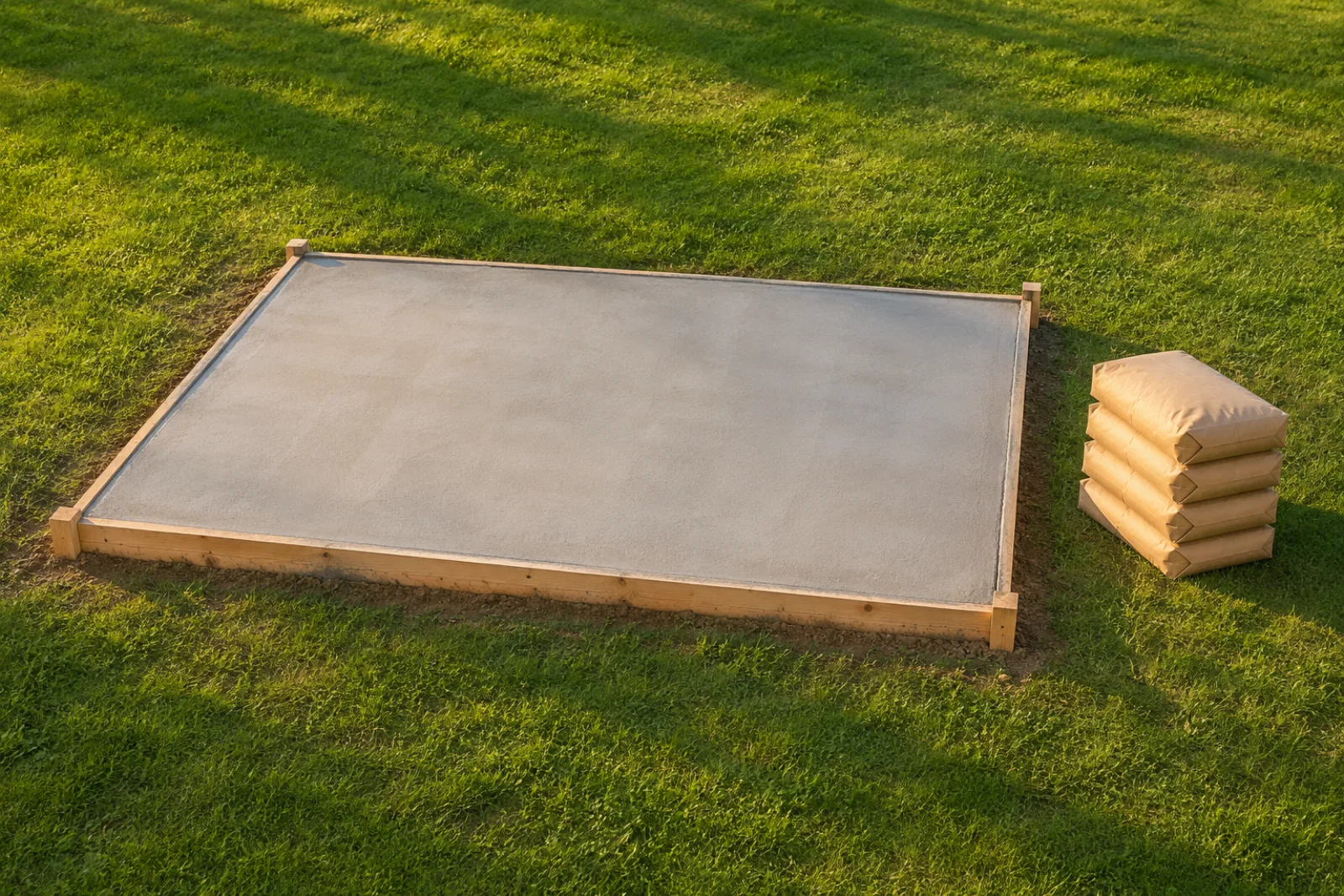
An 80 lb bag of concrete mix makes about 0.60 cubic feet, a 60 lb bag about 0.45 and a 40 lb bag about 0.30. Multiply length × width × thickness in feet to get cubic feet, divide by the bag yield and round up. A 10 × 10 ft slab 4 inches thick takes about 56 bags of 80 lb.
How much concrete does one bag make?
| Bag size | Yield per bag | Bags per cubic yard |
|---|---|---|
| 40 lb (18.1 kg) | 0.30 cu ft (8.5 L) | 90 |
| 50 lb (22.6 kg) | 0.375 cu ft (10.6 L) | 72 |
| 60 lb (27.2 kg) | 0.45 cu ft (12.7 L) | 60 |
| 80 lb (36.2 kg) | 0.60 cu ft (17 L) | 45 |
The yields come from the QUIKRETE Concrete Mix data sheet. A cubic yard is 27 cubic feet, so the last column is 27 divided by the yield. Other brands and other mixes (fast-setting, high-strength) can yield a little more or less, so check the number printed on your bag.
The formula
Bags = length (ft) × width (ft) × thickness (ft) ÷ yield per bag
Thickness is usually given in inches, so divide it by 12 first: 4 inches is 0.333 ft. Always round the result up to the next whole bag. Concrete Network has a shortcut for 4 inch slabs: square feet ÷ 81 = cubic yards.
In metric: cubic meters = area (m²) × thickness (cm) ÷ 100. Then divide by the litres per bag. A 10 m² slab 10 cm thick is 1 m³, or 1,000 L, which is 59 bags at 17 L each.
免费试用 LandLens
How thick should the slab be?
Concrete Network gives 4 inches as typical for residential patios, walkways and driveways, and 5 to 6 inches for garage floors and heavy-duty driveways. The QUIKRETE data sheet says its Concrete Mix is meant for pours 2 inches thick or more.
Bags per 100 square feet
| Thickness | Cubic yards | 80 lb bags | 60 lb bags | 40 lb bags |
|---|---|---|---|---|
| 4 inches | 1.23 | 56 | 75 | 112 |
| 5 inches | 1.54 | 70 | 93 | 139 |
| 6 inches | 1.85 | 84 | 112 | 167 |
These are exact volumes rounded up to whole bags, with nothing added for waste. Scale them to your area: 200 sq ft at 4 inches is 112 bags of 80 lb.
Step 1: Measure the area
- Rectangle: length × width. A 10 × 12 ft patio is 120 sq ft. The square footage calculator adds up several rectangles.
- L-shape: split it into two rectangles and add them.
- Curved or free-form slab: split it into simple shapes, or trace the outline on a map.
For curved patios and paths, LandLens lets you tap the corners on a satellite map or walk the edge with GPS, and it shows the area in square feet or square meters. Satellite images can be a little off at the edge of a narrow path, so check one width with a tape before you buy.
Step 2: Work out the bags
Example 1: 10 × 10 ft patio, 4 inches thick
- Volume = 10 × 10 × 0.333 = 33.3 cu ft (1.23 cubic yards)
- 80 lb bags = 33.3 ÷ 0.60 = 55.6, so 56 bags
- 60 lb bags = 33.3 ÷ 0.45 = 74.1, so 75 bags
Example 2: 4 × 4 ft pad, 4 inches thick
- Volume = 4 × 4 × 0.333 = 5.33 cu ft
- 80 lb bags = 5.33 ÷ 0.60 = 8.9, so 9 bags
- 60 lb bags = 5.33 ÷ 0.45 = 11.9, so 12 bags
Example 3: Fence post hole, 10 inches wide and 24 inches deep, 4 × 4 post
- Hole = 3.1416 × 5 × 5 × 24 = 1,885 cubic inches
- Post = 3.5 × 3.5 × 24 = 294 cubic inches (a 4 × 4 is really 3.5 inches square)
- Concrete = 1,591 cubic inches ÷ 1,728 = 0.92 cu ft
- 80 lb bags = 0.92 ÷ 0.60 = 1.5, so 2 bags per post, or 3 bags of 60 lb
This hole size is only an example. Check the post or fence maker's instructions for the hole width and depth your posts need, then run the same math.
For a whole fence, multiply by the number of posts. Measure the line first: how to measure a fence line shows how, and the fence calculator turns the length into a post count.
Order a little extra
Concrete Network's advice is never to order the exact amount. Ground is rarely perfectly flat, so it suggests budgeting for 1/4 inch more thickness than planned. For the 10 × 10 ft patio, 4 1/4 inches instead of 4 is 35.4 cu ft, or 60 bags of 80 lb instead of 56. Running short halfway through a pour is worse than carrying one bag back.
Bags or ready-mix?
Concrete Network suggests bags for smaller jobs such as walkways, small patios and footings, and ordering ready-mix by the yard for larger jobs such as driveways. A ready-mix plant will ask for the square footage and the thickness. Every cubic yard is 45 bags of 80 lb, so the mixing and lifting add up quickly. The concrete calculator gives the cubic yards and cubic meters to quote.
Base under the slab
Most slabs, pads and patios sit on a layer of compacted gravel. That is a separate order with its own math: see the gravel guide, and for paver patios how much paver base and sand you need.
Frequently asked questions
How many 80 lb bags of concrete are in a yard?
45. One cubic yard is 27 cubic feet, and an 80 lb bag makes about 0.60 cubic feet.
How many 60 lb bags of concrete are in a yard?
60. A 60 lb bag makes about 0.45 cubic feet, and 27 ÷ 0.45 = 60.
How many bags of concrete do I need for a 10 × 10 slab?
At 4 inches thick, about 56 bags of 80 lb or 75 bags of 60 lb. Budget about 4 more 80 lb bags for uneven ground.
How many bags of concrete for a fence post?
For a 4 × 4 post in a hole 10 inches wide and 24 inches deep, about 0.92 cubic feet of concrete: 2 bags of 80 lb or 3 bags of 60 lb. Wider or deeper holes need more, so run the numbers for your hole size.
Is it cheaper to buy bags or ready-mix?
It depends on local prices and delivery fees. Compare the price of the bags you need with a ready-mix quote for the same cubic yards, and count the labor of mixing 45 bags per yard.
相关工具和指南
分享您的反馈
帮助我们改进 LandLens。请求功能、报告错误或告诉我们您的想法。