How Many Pavers Do I Need? Pavers per Square Foot and Waste
LandLens6 मिनट में पढ़ें
How many pavers you need for a patio or walkway: pavers per square foot by size, how much extra to add for cuts by pattern, border pavers and worked examples.
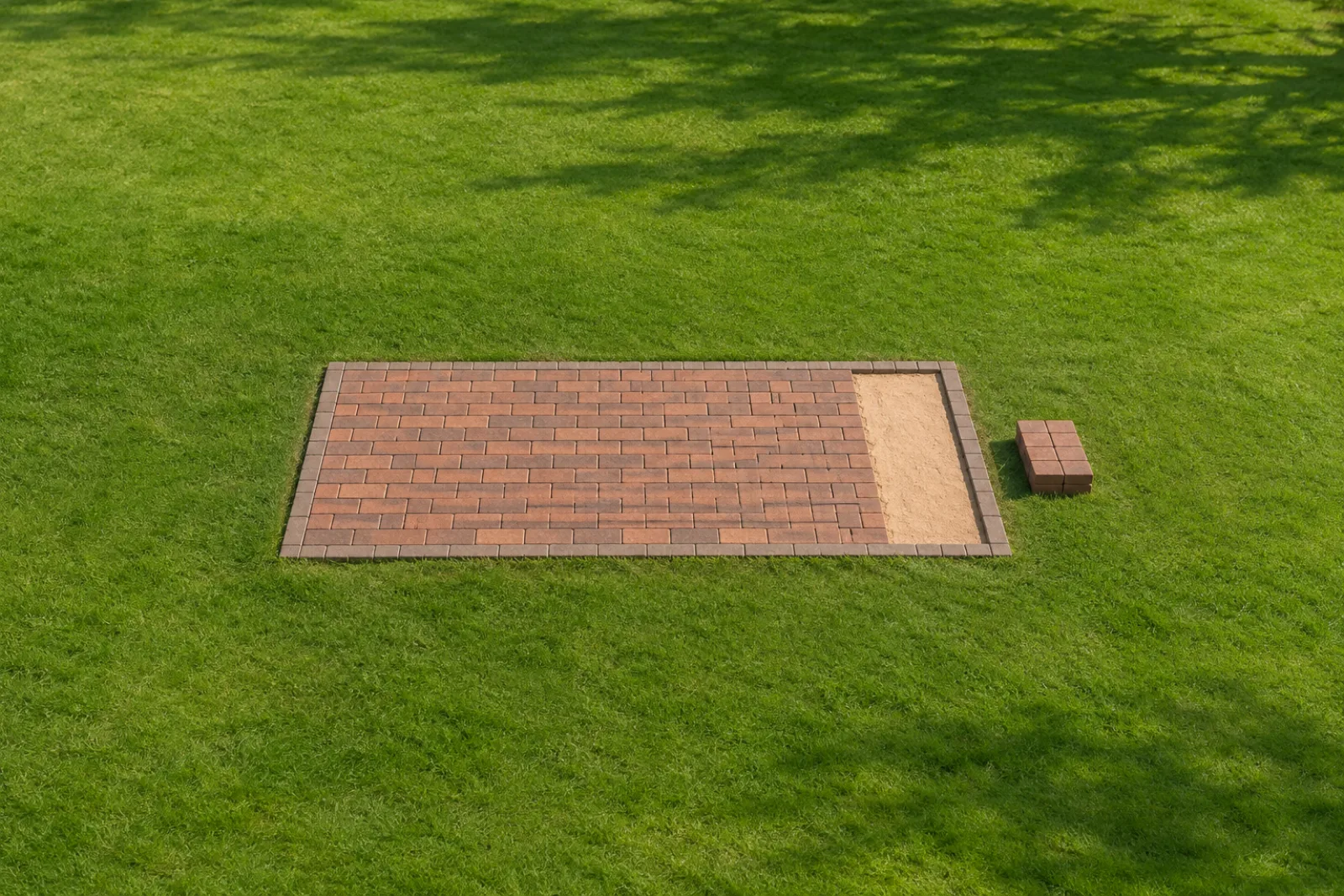
Divide the area by the size of one paver, then add 7 to 20% for cuts and breakage, depending on the pattern. A 4 × 8 inch brick paver covers 0.22 sq ft, so you need 4.5 per square foot, or 450 per 100 sq ft. Round up to full pavers, then to full pallets.
The formula
Pavers = area (sq ft) × pavers per sq ft × (1 + waste %)
To get pavers per square foot for any size, divide 144 by the paver's length × width in inches. A 6 × 9 inch paver is 54 square inches, so 144 ÷ 54 = 2.67 pavers per square foot. Inch Calculator's paver guide uses the same idea: patio square feet divided by the square feet of one paver, always rounded up to the next full paver.
In metric: pavers per m² = 10,000 ÷ (length × width in cm). A 10 × 20 cm paver covers 200 cm², so you need 50 per square meter.
Pavers per square foot by size
| Paver size (inches) | Area of one paver | Pavers per sq ft | Pavers per 100 sq ft |
|---|---|---|---|
| 4 × 8 | 0.22 sq ft | 4.5 | 450 |
| 6 × 6 | 0.25 sq ft | 4 | 400 |
| 6 × 9 | 0.38 sq ft | 2.67 | 267 |
| 12 × 12 | 1 sq ft | 1 | 100 |
| 16 × 16 | 1.78 sq ft | 0.56 | 56 |
| 24 × 24 | 4 sq ft | 0.25 | 25 |
These are counts before waste. Muthler Landscaping recommends the maker's own pieces per square foot, so if the spec sheet or pallet label lists it, use that number instead.
LandLens मुफ़्त आज़माएँ
How much extra to order for cuts
Every edge needs cut pavers, and some pavers break. The two guides behind this post give slightly different numbers, so use them as a range:
| Pattern or layout | Muthler Landscaping | Inch Calculator |
|---|---|---|
| Running bond or stack bond (straight) | 7% | at least 10% |
| Herringbone, angled layouts, circles | 12% | at least 20% for diagonal or multi-piece patterns |
Muthler Landscaping also notes that one paver maker it quotes suggests 10% for straight patterns and 15 to 20% for diagonal, herringbone or curved layouts. Use the low end for a simple rectangle and the high end for curves, many corners or a 45 degree pattern, where nearly every edge piece is a cut.
Step 1: Measure the area
- Rectangle: length × width. A 12 × 16 ft patio is 192 sq ft. The square footage calculator adds up several rectangles.
- L-shape: split it into two rectangles and add them.
- Round patio or fire pit area: use the circle area calculator.
- Curved walkway or free-form patio: trace the outline on a map.
For curved shapes, tracing is faster than a tape. In LandLens you tap the corners on a satellite map, or walk the edge with GPS, and the app shows the area and the perimeter. The perimeter is the number you need for border pavers below. Satellite images can be a little off along a narrow path, so check one width with a tape. For bigger yard projects, see how to measure your yard for landscaping.
Step 2: Work out the count
Example 1: 12 × 16 ft patio, 4 × 8 pavers, running bond
- Area = 12 × 16 = 192 sq ft
- Pavers = 192 × 4.5 = 864
- With 10% extra: 864 × 1.10 = 950.4, so order 951 pavers
Example 2: Same patio, 6 × 9 pavers, 7% extra
- 192 × 1.07 = 205.4 sq ft to cover
- 205.4 × 2.67 = about 548, so order about 550 pavers, the same figure Muthler Landscaping gets for this patio
Example 3: Curved walkway, 120 sq ft traced on a map, 4 × 8 herringbone
- Pavers = 120 × 4.5 = 540
- With 15% extra: 540 × 1.15 = 621 pavers
Border pavers
A border row (soldier course) is counted by length, not area. Muthler Landscaping gives these numbers for a 4 × 8 paver:
- Soldier course (long side across the border): 3 pavers per linear foot
- Sailor course (long side along the border): half as many, 1.5 per linear foot
The 12 × 16 ft patio has a perimeter of 56 ft, so a soldier course takes 56 × 3 = 168 pavers. For a curved edge, measure the perimeter on the map, or measure a straight run with the distance calculator. The border takes up part of the area, so for an exact count, subtract the border strip from the field area before you work out the field pavers.
Pallets and ordering
- Round up to full pallets. Muthler Landscaping lists pallets of 60 mm 4 × 8 pavers at 93 to 120 sq ft each, depending on the maker, so ask the supplier how many square feet the pallet of your exact paver covers.
- Order everything at once. A later order can come from a different production batch, and the color may not match.
- Plan the base too. Pavers sit on a compacted gravel base and a bedding sand layer. See how much paver base and sand you need for depths and cubic yards.
Frequently asked questions
How many pavers do I need for 100 square feet?
450 pavers of 4 × 8 inches, 400 of 6 × 6 inches, 267 of 6 × 9 inches or 100 of 12 × 12 inches, before waste. Add 7 to 20% for cuts depending on the pattern.
How many 12 × 12 pavers do I need?
One per square foot. A 10 × 10 ft area takes 100, plus about 10% for cuts in a straight pattern, so 110.
How many pavers are in a square meter?
Divide 10,000 by the paver's length × width in centimeters. A 10 × 20 cm paver gives 50 per m², a 20 × 20 cm paver 25 per m².
How much extra should I order for herringbone?
Between 12% and 20%. Muthler Landscaping uses 12% for herringbone and angled layouts; Inch Calculator says at least 20% for diagonal and multi-piece patterns. A 45 degree herringbone with many edges belongs at the high end.
Do I count the border pavers separately?
Yes. Count the border by length (3 pavers per foot for a 4 × 8 soldier course) and the field by area, then add both.
संबंधित उपकरण और गाइड
LandLens मुफ़्त आज़माएँ
अपने iPhone, iPad या Android फ़ोन से किसी भी भूमि क्षेत्र, दूरी या परिधि को मापें। उपकरण की आवश्यकता नहीं।
अपनी प्रतिक्रिया साझा करें
हमें LandLens में सुधार करने में मदद करें। सुविधाओं का अनुरोध करें, बग की रिपोर्ट करें, या हमें अपनी राय बताएं।