How Much Paver Base and Sand Do I Need? Depths and Cubic Yards
LandLens6 menit baca
How much paver base and sand you need for a patio, walkway or driveway: base and sand depths, the cubic yard formula, a coverage table and worked examples.
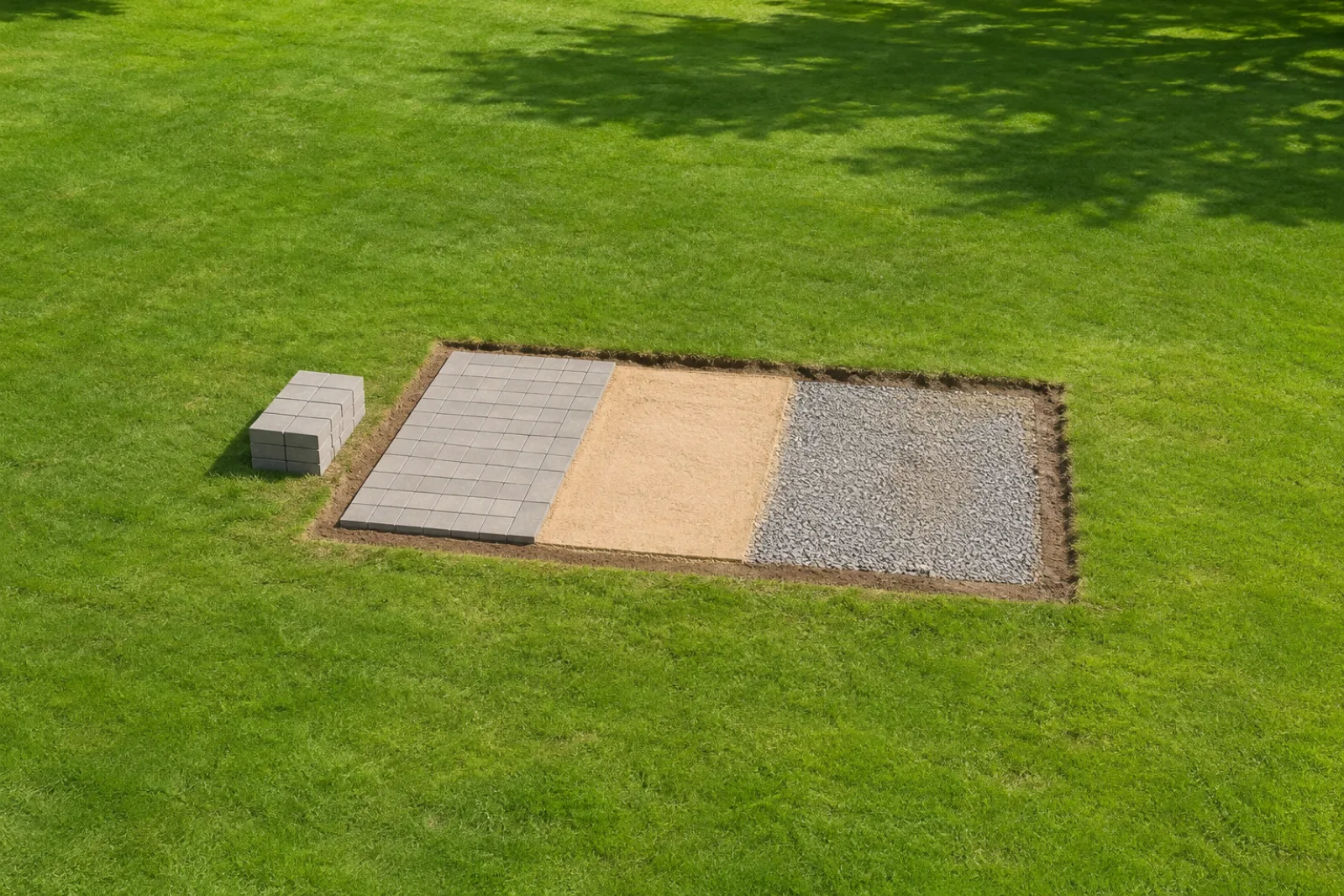
A typical paver patio or walkway needs a 4 to 6 inch layer of compacted gravel base and a 1 inch layer of bedding sand. Driveways need 6 to 8 inches of base. To get cubic yards, multiply the area in square feet by the depth in inches, divide by 324, and add about 20% to the gravel for compaction.
How deep should paver base and sand be?
| Project | Gravel base | Bedding sand |
|---|---|---|
| Patio or walkway | 4 to 6 inches | 1 inch |
| Driveway or heavy-duty area | 6 to 8 inches | 1 inch |
These ranges come from Inch Calculator's paver base guide. Iowa State University Extension gives one recipe for a paver job: 5 inches of quarried gravel (3/4 inch and smaller) and 1 1/2 inches of concrete sand, and it says the sand should never be deeper than 1 1/2 inches. Use the deeper end of the base range on soft or wet soil and anywhere a car will drive.
The formula
Cubic yards = area (sq ft) × depth (inches) ÷ 324
The 324 is 27 cubic feet in a cubic yard times 12 inches in a foot. Run it twice: once for the gravel base and once for the sand.
- Gravel base: add 20% for compaction. Loose gravel shrinks when you compact it, and Inch Calculator builds the same 20% into its results.
- Sand: no compaction allowance. The bedding sand is screeded flat and not compacted on its own.
In metric: cubic meters = area (m²) × depth (cm) ÷ 100. A 20 m² patio with a 12 cm base needs 2.4 m³ of gravel before the 20%, so order about 2.9 m³.
Coba LandLens gratis
How much you need per 100 square feet
| Layer and depth | Cubic yards per 100 sq ft | With 20% for compaction |
|---|---|---|
| Gravel base, 4 inches | 1.23 | 1.48 |
| Gravel base, 6 inches | 1.85 | 2.22 |
| Gravel base, 8 inches | 2.47 | 2.96 |
| Sand, 1 inch | 0.31 | not needed |
| Sand, 1 1/2 inches | 0.46 | not needed |
One cubic yard is 27 cubic feet, so 0.31 cubic yards of sand is about 8.3 cubic feet.
How deep to dig
Dig depth = base depth + sand depth + paver thickness. Iowa State Extension's example uses 5 inches of base, 1 1/2 inches of sand and pavers about 3 1/2 inches thick, so it removes 10 inches of soil from the whole area. Check the thickness of your pavers on the product label before you dig.
Step 1: Measure the area
Every number above depends on the square footage, so measure it first:
- Rectangle: length × width. A 12 × 16 ft patio is 192 sq ft. The square footage calculator handles several rectangles at once.
- L-shape: split it into two rectangles and add them.
- Curved walkway or free-form patio: split it into simple shapes, or trace the outline on a map.
For curved paths and odd-shaped patios, tracing is faster than a tape. In LandLens you tap the corners on a satellite map, or walk the edge with GPS, and the app shows the area in square feet or square meters. Satellite images can be a little off at the edge of a narrow path, so check one width with a tape. For bigger landscaping jobs, see how to measure your yard for landscaping.
Step 2: Work out each layer
Example 1: 12 × 16 ft patio, 4 inch base, 1 inch sand
- Area = 12 × 16 = 192 sq ft
- Base = 192 × 4 ÷ 324 = 2.37 cubic yards, plus 20% = 2.84, so order 3 cubic yards
- Sand = 192 × 1 ÷ 324 = 0.59 cubic yards, about 16 cubic feet
Example 2: Curved walkway, 120 sq ft traced on a map
- Base at 4 inches = 120 × 4 ÷ 324 = 1.48 cubic yards, plus 20% = 1.78 cubic yards
- Sand at 1 inch = 120 ÷ 324 = 0.37 cubic yards, about 10 cubic feet
Example 3: 10 × 40 ft paver driveway, 8 inch base
- Area = 400 sq ft
- Base = 400 × 8 ÷ 324 = 9.88 cubic yards, plus 20% = 11.85, so order 12 cubic yards
- Sand at 1 inch = 400 ÷ 324 = 1.23 cubic yards
Bags, bulk and tons
Bulk gravel and sand are sold by the cubic yard or by the ton. The weight of a cubic yard depends on the stone and how wet it is, so ask the supplier for the weight per cubic yard of the exact product before you convert. Bagged sand and base show their volume or coverage on the label: divide your cubic feet by the cubic feet per bag and round up. For loose stone in general, the gravel guide walks through the same math for driveways and paths.
Tips that keep pavers flat
- Use concrete sand for the bedding. Iowa State Extension warns against limestone screenings or stone dust in place of sand.
- Compact the base, not the bedding sand. Compact the gravel with at least two passes of a plate compactor, then screed the sand and lay the pavers on it without compacting it first.
- Keep the base even. Iowa State's tolerance is no more than 1/2 inch up or down over 10 feet.
- Slope for drainage. A drop of 2 inches for every 8 feet, away from buildings. The slope calculator converts that to percent grade.
- Install edging. Edge restraints stop the pavers from shifting; some types go in before the sand.
Frequently asked questions
How much paver base do I need for 100 square feet?
At 4 inches deep, 1.23 cubic yards, or about 1.5 cubic yards with 20% for compaction. At 6 inches, 1.85 cubic yards, or about 2.2 with compaction.
How much sand do I need under pavers?
A 1 inch layer: area in square feet ÷ 324 = cubic yards. That is 0.31 cubic yards (about 8.3 cubic feet) per 100 sq ft.
Can I use 2 inches of sand under pavers?
It is not recommended. Iowa State Extension sets 1 1/2 inches as the maximum sand depth. Fix low spots in the gravel base rather than making the sand layer thicker.
Do you compact the sand before laying pavers?
No. Iowa State Extension says not to compact the bedding sand. You compact the pavers after they are laid, which settles them into the sand.
How deep do I dig for a paver patio?
Add the base depth, the sand depth and the paver thickness. A 4 inch base, 1 inch of sand and a paver about 2 inches thick means digging about 7 inches.
Alat & panduan terkait
Coba LandLens gratis
Ukur area lahan, jarak, atau keliling apa pun dengan iPhone, iPad, atau ponsel Android Anda. Tanpa peralatan.
Bagikan Umpan Balik Anda
Bantu kami meningkatkan LandLens. Minta fitur, laporkan bug, atau beri tahu kami apa yang Anda pikirkan.