How to Calculate How Much Sod You Need
Sod is sold by the square foot or by the pallet. The calculation is simple once you know your lawn's square footage:
Sod needed (sq ft) = Lawn area (sq ft) × 1.10
The 10% overage accounts for cuts around edges, curves, obstacles, and any pieces damaged during installation. For complex or heavily irregular yards, bump that to 15%.
To convert to pallets:
Pallets needed = Total sq ft ÷ Coverage per pallet
Standard pallet coverage in the US is 450 square feet, though this varies by supplier and grass type (see table below).
Standard Pallet Sizes
| Sod Type | Typical Pallet Coverage | Pieces per Pallet | Piece Size |
|---|---|---|---|
| Bermuda | 450 sq ft | 171 pieces | 16" × 24" |
| Zoysia | 450 sq ft | 171 pieces | 16" × 24" |
| St. Augustine | 400–500 sq ft | Varies | 16" × 24" |
| Tall Fescue | 450 sq ft | 171 pieces | 16" × 24" |
| Kentucky Bluegrass | 450 sq ft | 171 pieces | 16" × 24" |
| Centipede | 400 sq ft | Varies | 16" × 24" |
Always confirm pallet size with your sod farm or nursery before ordering — coverage can differ by 10–15% depending on how thick each roll is cut.
Step-by-Step Calculation Examples
Example 1: Simple Rectangular Yard
Your backyard is 50 feet wide and 40 feet long. You want Bermuda sod.
- Area = 50 × 40 = 2,000 sq ft
- With 10% waste = 2,000 × 1.10 = 2,200 sq ft
- Pallets = 2,200 ÷ 450 = 4.9 → round up to 5 pallets
Example 2: L-Shaped Yard
Your yard has an L-shape. The main section is 60 × 30 ft and the side section is 20 × 15 ft.
- Main section = 60 × 30 = 1,800 sq ft
- Side section = 20 × 15 = 300 sq ft
- Total area = 2,100 sq ft
- With 15% waste (irregular shape) = 2,100 × 1.15 = 2,415 sq ft
- Pallets = 2,415 ÷ 450 = 5.4 → round up to 6 pallets
Example 3: Yard with Existing Features to Subtract
Your front yard measures 80 × 35 ft (2,800 sq ft), but it has a 10 × 20 ft concrete walkway and a 15 × 15 ft flower bed that won't be sodded.
- Total yard = 2,800 sq ft
- Subtract walkway = −200 sq ft
- Subtract flower bed = −225 sq ft
- Net sod area = 2,375 sq ft
- With 10% waste = 2,375 × 1.10 = 2,613 sq ft
- Pallets = 2,613 ÷ 450 = 5.8 → round up to 6 pallets
Sod Type Comparison
Choosing the right grass for your climate and usage is just as important as the quantity calculation. The wrong grass in the wrong climate will struggle regardless of how well you install it.
| Grass Type | Climate | Sun Requirements | Traffic Tolerance | Drought Tolerance | Maintenance Level |
|---|---|---|---|---|---|
| Bermuda | Warm (South, Southwest) | Full sun | Excellent | High | High |
| Zoysia | Warm to transition zone | Full sun to partial | Good | Good | Medium |
| St. Augustine | Hot, humid (Gulf Coast, FL) | Full sun to partial | Moderate | Low–Moderate | Medium |
| Tall Fescue | Transition zone, Pacific NW | Full sun to partial | Moderate | Moderate | Low–Medium |
| Kentucky Bluegrass | Cool (North, Midwest) | Full to partial sun | Good | Low | Medium–High |
| Centipede | Southeast | Full sun | Low | Moderate | Very Low |
Sod Cost by Type and Region in 2026
Sod pricing varies widely by grass type, region, and whether you're buying directly from a sod farm or through a landscaping contractor. These are typical retail pallet prices; contractor bulk pricing is generally 20–35% lower.
| Grass Type | Cost per Pallet (450 sq ft) | Cost per Square Foot | Where It's Common |
|---|---|---|---|
| Bermuda (common) | $150 – $250 | $0.33 – $0.55 | Southeast, Southwest, Texas |
| Bermuda (hybrid: Celebration, Tifway) | $250 – $400 | $0.55 – $0.89 | Golf courses, premium lawns |
| Zoysia (Empire, Emerald) | $250 – $450 | $0.55 – $1.00 | Southeast, Mid-Atlantic |
| St. Augustine (Floratam) | $200 – $350 | $0.44 – $0.78 | Florida, Gulf Coast |
| Tall Fescue | $200 – $375 | $0.44 – $0.83 | Mid-Atlantic, Pacific NW |
| Kentucky Bluegrass | $300 – $500 | $0.67 – $1.11 | Midwest, Northeast, Rockies |
| Centipede | $150 – $275 | $0.33 – $0.61 | Southeast |
Add $0.50–$1.50 per square foot for professional installation labor, which typically includes site prep, rolling, and initial watering. Total installed cost for a 2,000 sq ft lawn commonly runs $1,500–$5,000 depending on location and grass type.
Don't Forget the Waste Factor
The waste factor is not just a rough buffer — here is where it actually goes:
- Edge cuts: Every time sod meets a curved bed edge, sidewalk, or structure, you cut a piece. These off-cuts are rarely reusable.
- Damaged pieces: Sod pieces can tear during unloading or placement, especially in summer heat.
- Uneven seams: Gaps at seams need filling with small pieces cut from larger rolls.
- Dead spots: Even with perfect installation, occasional pieces fail. Having 10% extra lets you patch without reordering.
Use the lower 10% waste factor for simple rectangular lawns. Use 15% for yards with multiple curves, garden beds, trees, or other obstacles requiring many cuts.
Sod Installation Tips
Timing Matters
Warm-season grasses (Bermuda, Zoysia, St. Augustine) should be installed from late spring through early summer when soil temperatures are above 65°F. Cool-season grasses (Fescue, Bluegrass) install best in early fall or early spring. Avoid installing sod during peak summer heat — the roots won't establish before the plant desiccates.
Prepare the Soil First
Sod installed over hard, compacted, or nutrient-poor soil will struggle to root. Remove existing grass and weeds, till the top 4–6 inches, and amend with compost if your soil is heavy clay or pure sand. Grade the surface so it slopes away from your foundation at roughly 1–2% slope.
Lay in a Brick Pattern
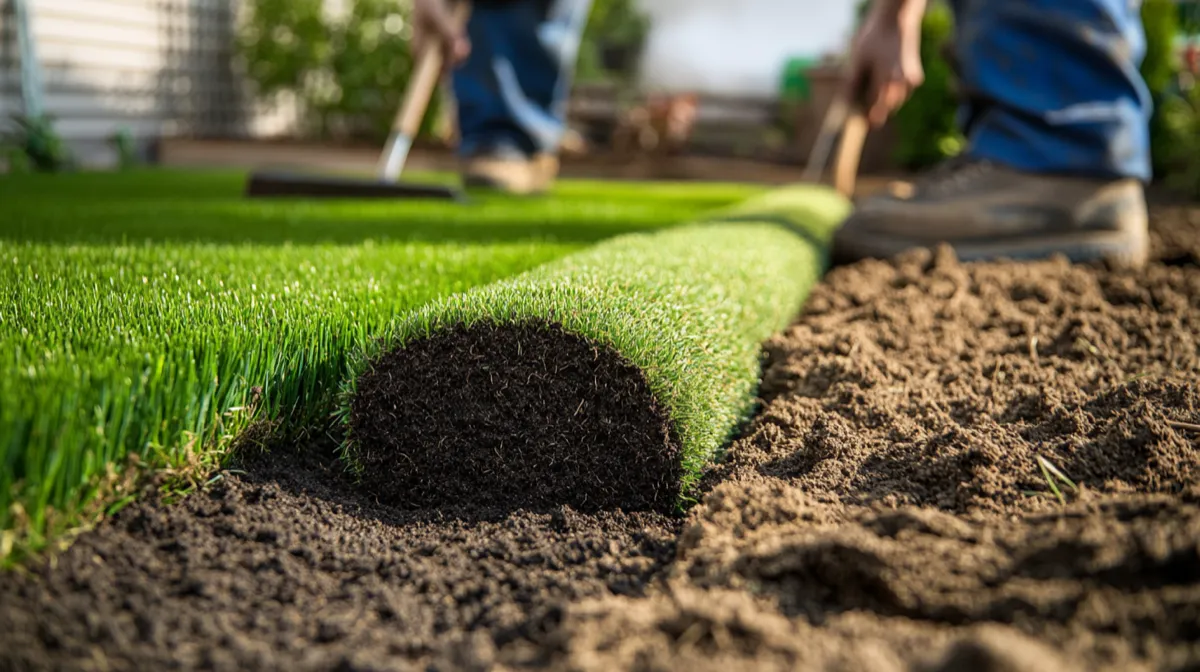
Stagger sod rows like brickwork — never line up seams in the same row. Seams that align create channels where water runs and can cause edges to dry out or separate. Butt pieces tightly together; gaps allow weeds in and edges to die back.
Water Immediately and Aggressively
Sod must be watered within 30 minutes of installation. For the first two weeks, keep the soil moist 3–4 inches deep. This typically means watering twice daily during summer installation. Reduce frequency once roots are established (check by gently tugging a corner — if it resists, roots are forming).
Stay Off It
Keep foot traffic to a minimum for the first 2–3 weeks. Sod pieces can shift before roots have anchored them to the subsoil.
Measure Your Yard Accurately Before You Order
Ordering too little means a second delivery fee and potential delays if your sod farm sells out. Ordering too much means wasted material and money — sod has a shelf life of 24–48 hours in summer heat.
For a simple rectangular yard, a tape measure works. For any yard with curves, irregular edges, garden beds, or obstacles, use LandLens to trace your lawn's actual boundary using GPS. The app calculates the exact square footage in real time — including the ability to subtract interior areas like patios and flower beds. You'll know precisely how many pallets to order before you ever call a sod supplier.
Download LandLens on the App Store and get an accurate measurement in minutes.
Frequently Asked Questions
How many square feet does one pallet of sod cover?
Most pallets in the US cover 450 square feet, though some suppliers cut pieces slightly thicker or thinner, resulting in coverage between 400–500 sq ft. Always confirm with your supplier before ordering.
How long does sod last once delivered?
Sod must be installed within 24 hours of delivery in summer (soil temperatures above 80°F). In cooler weather (below 60°F), you may have 48–72 hours. Sod left on pallets generates heat from decomposition and can die from the inside out. Coordinate delivery and installation the same day whenever possible.
Should I sod or seed?
Sod gives you an instant lawn and is more forgiving of imperfect timing, but costs 5–10× more than seeding. Seed is cheaper and produces a stronger root system over time, but requires 8–12 weeks before you can use the lawn and is more vulnerable to drought, birds, and washout. For high-visibility areas (front yards) or when timing is tight, sod is usually the better choice.
Can I install sod in the summer?
Yes, but it requires aggressive watering — often twice daily for 2–3 weeks. Water bills increase substantially. If you're in a region with water restrictions, consult local regulations before a summer sod installation. Early fall is generally the ideal time for cool-season grasses; late spring for warm-season grasses.
Related tools & guides
Try LandLens free
Measure any land area, distance, or perimeter with your iPhone, iPad or Android phone. No equipment needed.
Share Your Feedback
Help us build a better LandLens. Request features, report bugs, or tell us what you think.