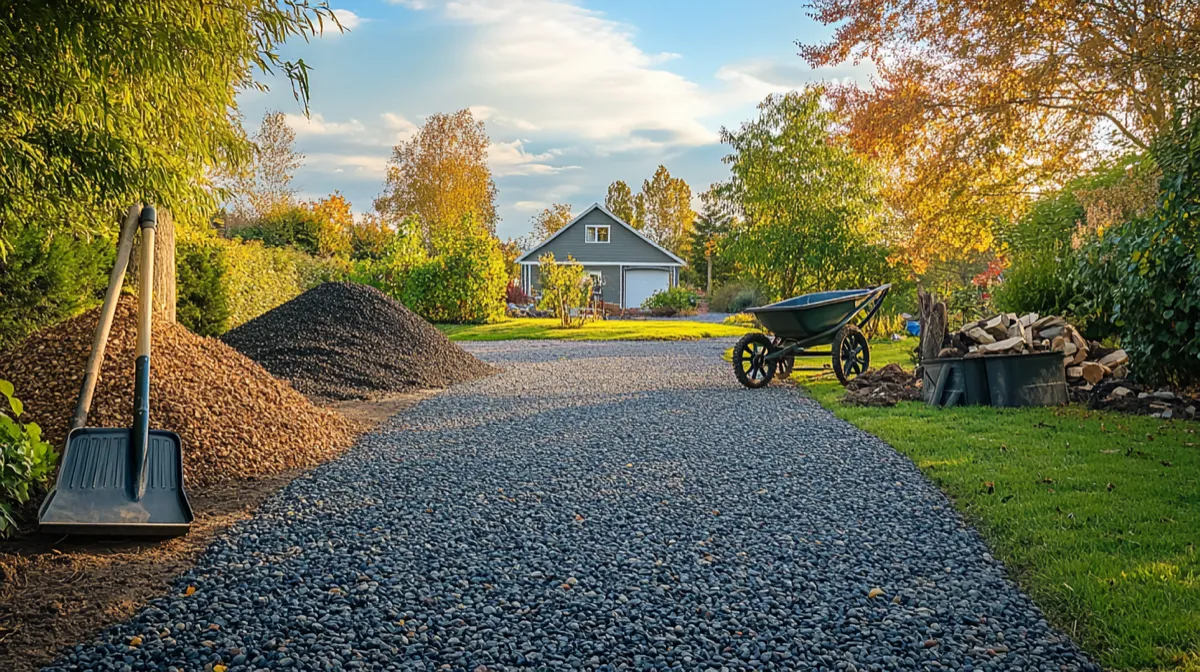
How to Calculate How Much Gravel You Need
The core formula is straightforward:
Volume (cubic yards) = Length (ft) × Width (ft) × Depth (ft) ÷ 27
You divide by 27 because there are 27 cubic feet in one cubic yard — the unit gravel is almost always sold in for bulk delivery. If you prefer cubic feet, just skip the ÷ 27 step.
For example, a driveway that is 60 feet long × 12 feet wide × 0.33 feet deep (4 inches) requires:
60 × 12 × 0.33 ÷ 27 = 8.8 cubic yards
At roughly 1.4 tons per cubic yard for crushed stone, that is about 12.3 tons of gravel.
Recommended Gravel Depth by Application
Depth is the variable most people underestimate. Going too shallow means the gravel shifts, ruts, and disappears into the soil within a season.
| Application | Recommended Depth | Notes |
|---|---|---|
| Driveway (passenger cars) | 4 inches (0.33 ft) | Two 2-inch layers: base + surface |
| Driveway (heavy trucks/RVs) | 6 inches (0.5 ft) | Compacted base layer is critical |
| Garden path / walkway | 2–3 inches (0.17–0.25 ft) | Edging required to keep gravel in place |
| Decorative landscaping beds | 2 inches (0.17 ft) | Landscape fabric underneath recommended |
| French drain / drainage trench | Fill trench completely | Use ¾" clean crushed stone or pea gravel |
| Under concrete slab | 4–6 inches (0.33–0.5 ft) | Well-compacted base, prevents cracking |
| Playground / play area | 6–12 inches (0.5–1 ft) | IPEMA standards for fall protection |
Gravel Types and What They're Best For
Not all gravel is the same. The type you choose affects both the final look and the performance of your project.
Pea Gravel
Small, rounded stones (3/8 inch) that are smooth to the touch. Popular for patios, playgrounds, and garden paths. Because the stones are round, they don't compact well — which makes them comfortable underfoot but poor for driveways. Expect to rake them back into place after rain or heavy foot traffic.
Crushed Stone (#57 or #411)
Angular, irregular pieces of limestone, granite, or traprock. The sharp edges interlock and compact into a stable surface, making crushed stone the go-to choice for driveways and base layers. #57 stone (¾ inch) is the most common driveway gravel in the US. #411 (a blend of #57 and stone dust) packs even more firmly.
River Rock
Larger, smooth stones worn by water, typically 1–3 inches. Used primarily for decorative landscaping, dry creek beds, and erosion control on slopes. Not suitable for driveways or paths due to the rolling, unstable surface.
Decomposed Granite (DG)
Fine, sand-like granite particles that compact into a firm, natural-looking surface. Excellent for paths, patios, and desert landscaping. When stabilized with a binder, DG behaves almost like a permeable pavement. Common in Western US climates; it can wash away quickly in wet regions without proper edging and stabilizer.
Marble Chips
White or light-colored decorative stone. Used almost exclusively in ornamental landscape beds and around formal plantings. Price is higher than standard gravel but the aesthetic impact is significant.
Coverage Per Ton by Gravel Type
Gravel density varies by type and particle size. These figures are approximate — ask your supplier for the exact weight per cubic yard of the specific product you're buying.
| Gravel Type | Weight per Cubic Yard | Coverage at 2" depth (per ton) | Coverage at 4" depth (per ton) |
|---|---|---|---|
| Crushed stone (#57) | ~1.4 tons | ~160 sq ft | ~80 sq ft |
| Pea gravel | ~1.3 tons | ~170 sq ft | ~85 sq ft |
| River rock (1–2") | ~1.35 tons | ~165 sq ft | ~83 sq ft |
| Decomposed granite | ~1.5 tons | ~150 sq ft | ~75 sq ft |
| Marble chips | ~1.2 tons | ~185 sq ft | ~93 sq ft |
Gravel Cost Per Ton in 2026
Prices vary significantly by region, quantity ordered, and supplier. These are national averages for bulk delivery orders of 5 tons or more. Smaller orders and bagged gravel cost considerably more per ton.
| Gravel Type | Cost Per Ton (Bulk Delivery) | Cost Per Cubic Yard |
|---|---|---|
| Crushed stone (#57) | $30 – $55 | $42 – $77 |
| Pea gravel | $35 – $60 | $45 – $78 |
| River rock | $45 – $85 | $60 – $115 |
| Decomposed granite | $40 – $70 | $60 – $105 |
| Marble chips | $100 – $200 | $120 – $240 |
| Base gravel / road base | $18 – $35 | $25 – $49 |
Add $50–$150 per load for delivery, depending on distance and supplier minimums. Most suppliers require a minimum order of 1–3 tons for delivery.
Bulk Delivery vs. Bagged Gravel
For any project over about 0.5 cubic yards (roughly 14 bags of 50 lb gravel), bulk delivery almost always wins on cost.
| Bulk Delivery | Bagged (0.5 cu ft bags) | |
|---|---|---|
| Cost per cubic yard | $42 – $77 (crushed stone) | $140 – $200+ |
| Minimum order | 1–3 tons typical | No minimum |
| Convenience | Requires driveway access for dump truck | Available at any hardware store |
| Best for | Projects over 0.5 cu yd | Small repairs, tight access areas |
If your project is in a backyard where a truck cannot access, or if you simply need to fill a small pothole or top off a garden bed, bagged gravel from a hardware store is perfectly reasonable — just budget 2–3× the cost per unit.
Step-by-Step Calculation Examples
Example 1: Gravel Driveway
Your driveway is 80 feet long and 14 feet wide. You want 4 inches (0.33 ft) of crushed stone (#57).
- Volume = 80 × 14 × 0.33 ÷ 27 = 13.7 cubic yards
- Weight = 13.7 × 1.4 tons/yd³ = 19.2 tons
- Cost estimate = 19.2 tons × $40/ton avg = ~$768 plus delivery
Example 2: Garden Path
A winding path through your garden is 45 feet long and 3 feet wide. You want pea gravel at 2.5 inches (0.21 ft) deep.
- Volume = 45 × 3 × 0.21 ÷ 27 = 1.05 cubic yards
- Weight = 1.05 × 1.3 = 1.4 tons
- Since this is under the bulk delivery minimum, consider 3 bags of 0.5 cu ft bagged pea gravel per linear foot, or about 45 × 3 × (2.5/12) ÷ 0.5 = ~56 bags from the hardware store
Example 3: Decorative Landscape Beds
Three landscape beds totaling 400 square feet. You want river rock at 2 inches (0.17 ft) deep.
- Volume = 400 × 0.17 ÷ 27 = 2.5 cubic yards
- Weight = 2.5 × 1.35 = 3.4 tons
- Cost estimate = 3.4 × $60 avg = ~$204 plus delivery
Tips for Getting Your Gravel Project Right
- Order 10% extra. Gravel settles and compacts after delivery. It's always cheaper to have a small surplus than to pay for a second delivery.
- Install landscape fabric under decorative gravel to prevent weeds from pushing through over time. Skip it under driveways — the fabric can interfere with compaction and drainage.
- Compact your base. For driveways, rent a plate compactor ($80–$120/day) and compact every 2-inch lift. A loose base leads to ruts and sinkholes.
- Use edging. Steel, aluminum, or plastic landscape edging keeps gravel in place on paths and beds. Without it, you'll be raking wayward stones back for years.
- Ask about delivery placement. Dump trucks typically drop the load in one pile. Confirm with the driver where the pile should go — moving 15 tons of gravel by wheelbarrow is a significant job.
The Hardest Part: Measuring the Area Accurately
The formula is simple. The challenge is getting accurate measurements, especially for irregular areas — curving driveways, oddly shaped garden beds, or L-shaped paths.
For rectangular spaces, a tape measure works fine. But for any irregular shape, try measuring your project area with LandLens. Walk the perimeter of your driveway, garden bed, or landscape zone and the app calculates the exact square footage in real time using GPS. Multiply by your intended depth and you have a precise material estimate — no guessing, no manual geometry.
Download LandLens on the App Store and measure your project before calling the gravel supplier: LandLens — Land Area Measure & GPS
Frequently Asked Questions
How many cubic yards of gravel do I need for a 10×10 area?
At 2 inches deep: 10 × 10 × 0.17 ÷ 27 = 0.63 cubic yards (about 0.8 tons of crushed stone). At 4 inches deep: 10 × 10 × 0.33 ÷ 27 = 1.2 cubic yards (about 1.7 tons).
How much does a truckload of gravel cost?
A standard dump truck carries 10–14 tons of gravel. At $30–$55 per ton for crushed stone, a full truckload runs $300–$770 for material, plus $50–$150 for delivery. Total: roughly $350–$920 per truckload depending on material type and your location.
What is the best gravel for a driveway?
Crushed stone #57 (¾ inch angular limestone or granite) is the most widely recommended driveway gravel in the US. The angular edges lock together under traffic and drain well. For the best result, use a two-layer approach: #21A (or road base) as the 4-inch compacted base, then #57 as the 2-inch surface layer.
How deep should I put gravel?
For driveways: 4 inches minimum, 6 inches for truck or RV traffic. For pedestrian paths: 2–3 inches. For decorative beds: 2 inches is adequate and keeps costs down.
Related tools & guides
Try LandLens free
Measure any land area, distance, or perimeter with your iPhone, iPad or Android phone. No equipment needed.
Share Your Feedback
Help us build a better LandLens. Request features, report bugs, or tell us what you think.